The short answer is no they are different but people often do treat them the same.
First, I need to make a distinction between the company (the certificate authority) and the instrument (public certificate) that is used in a chain of trust. (see definition later)
Certificate Authority (CA) - A company and software that produces certificates for others to use. CA's generate a public key certificate and a private key for use on the web, see also Wikipedia's definition.
A certificate authority can have one or more certificates that they use for different purposes.
Google, for example, has a Root CA as well as an Intermediate CA as is found in the cert at www.google.com:
GTS Root 1
    + GTS CA 1C3
        + *.google.com
In this example, the final cert *.google.com was signed by an intermediate CA GTS CA 1C3 which was signed by the root CA GTS Root 1.
So to answer your question:
Are Trust anchors and (root) certificates authorities the same thing?
Given that people often say "Root CA" to mean the public certificate used to form the chain of trust in a certificate chain, then they are the same thing. In the example, the trust anchor GTS Root 1 could also be called the Root CA.
But I would not ever say the trust anchor GTS Root 1 is the Root Certificate Authority because spelling it out seems to indicate the company not the certificate.
The details of this answer
When trying to write this up I came across the following that I found helpful, so others might as well.
Some definitions are in order
Trust Anchor - refers to the top most certificate in a certificate chain of trust. A certificate is signed by a CA or it is a Root CA which is self signed. Also see Wikipedia's Trust anchor.
Chain of Trust - a chain of trust is a sequence of public certificates starting with the end certificate and going to the top of the chain of trust (called the Trust Anchor).
Self Signed Certificate - A certificate who's issuer is the same as the name of the cert. Technically, the issuer is the same as the subject. Root Certificates are by definition self signed.
It's important to note that developers often create self-signed certificates for use in development which are not considered Root Certs.
Root Certificate - a self signed cert where the issuer matches the subject. It's considered a root because another Intermediate certs refers to it. And it's placed in a Trust Store (see below).
Intermediate Certificate - if a certificate is signed by another certificate (higher in the chain of trust), it is called an Intermediate Certificate.
Trusted Root Certificate Store (aka TrustStore in Java)- refers to a container that holds a list of trusted certificates. These are either intermediate certificates or root certificates.
A trust anchor refer to the top-most certificate in a certificate chain. The top-most certificate can (and often is) a certificate in a root store but not always (in a developers self signed cert).
Wikipedia describes the Chain of Trust with a diagram that shows this how the subject and issuer work together to form the chain of trust.
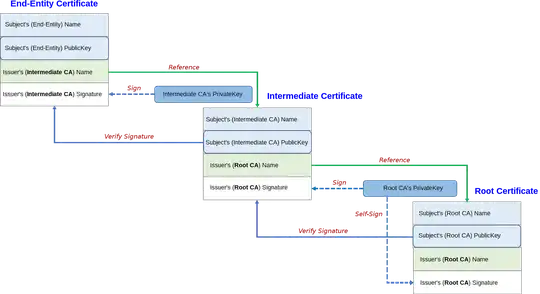
By Fanyangxi - https://en.wikipedia.org/wiki/File:Chain_Of_Trust.svg, CC BY-SA 4.0, https://commons.wikimedia.org/w/index.php?curid=126523095


